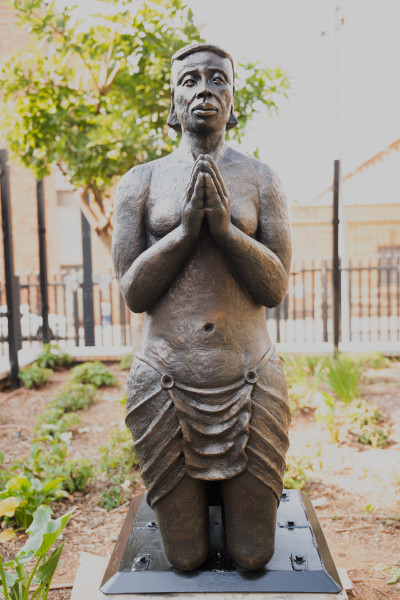
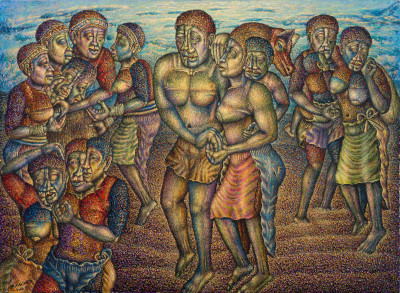
Helen Sebidi (b. 1943) is one of the most prominent painters and sculptors to emerge from South Africa in the later 20th century and whose practice draws on a depth of cultural, spiritual and personal experience that sets her apart from her contemporaries. Born in Marapyane, in what is now the North West province, she was raised largely by her grandmother, from whom she absorbed oral traditions, ancestral knowledge and a sense of the inseparability of human, animal and spiritual existence. These formative early experiences have remained central to her art throughout her career.
Sebidi received no formal art training in her early years, working instead in domestic service and other forms of employment while developing her creative practice through informal means. Her path to recognition as a professional artist came through contact with artist-teachers such as Bill Ainslie at the Johannesburg Art Foundation, where she received both encouragement and technical guidance for a practice already fully formed in its essential vision.
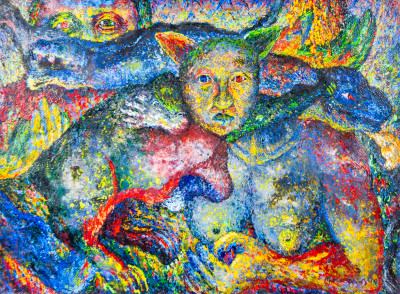
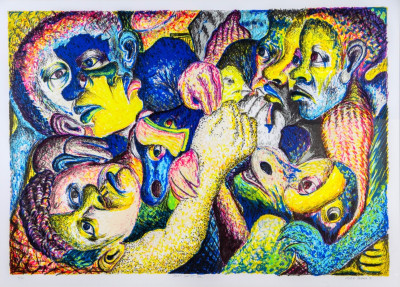
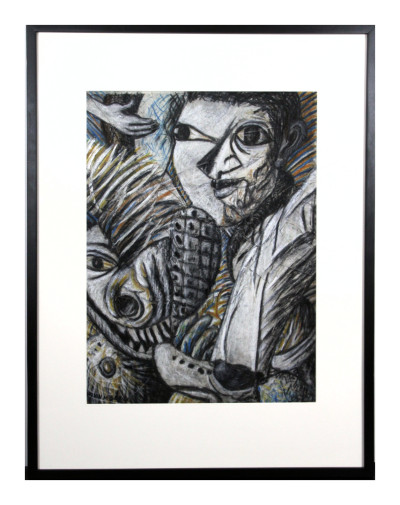
Her paintings and sculptures are characterised by their extraordinary density of form: figures, animals, plants and ancestral presences fill her canvases in complex, layered arrangements that give visual expression to a world in which the boundaries between different orders of being are continuously permeable.
Sebidi received the Standard Bank Young Artist Award in 1989 and has since been the subject of major retrospective exhibitions and sustained critical attention. Her work is held in significant South African and international collections and has been exhibited in Africa, Europe and North America.
She is celebrated as one of the most visionary artists South Africa has produced, an artist whose practice is inseparable from her cultural inheritance and whose formal achievement matches the depth of her vision.