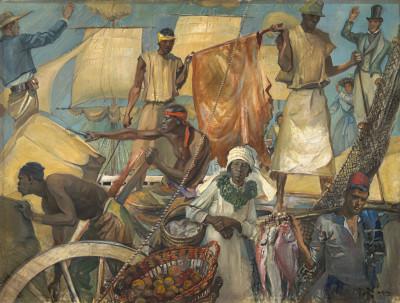
Dorothy Kay (1886–1964) was an Irish-born South African painter, printmaker and illustrator whose career combined technical mastery with a disciplined eye for people at work and in daily life. Born in Dublin, she trained at the Dublin Metropolitan School of Art before settling in South Africa, where she became a significant presence in the cultural life of the Eastern Cape.
She was a founding member of the Eastern Province Society of Arts and Crafts and contributed to the development of artistic infrastructure in a region that lacked the institutional support available in Johannesburg or Cape Town.
Kay is especially celebrated for the quality of her draughtsmanship, portraiture and ability to organise complex multi-figure compositions with clarity and authority. During the 1930s and 1940s she undertook a series of ambitious commissions that required her to record surgery in progress, industrial processes and commercial activity with the kind of precision normally associated with documentary illustration. These works combine observational accuracy with a strong sense of pictorial design, drawing on the traditions of European social realism while remaining grounded in the specific social and material realities of South African life.
Her printmaking, particularly her woodcuts and linocuts, demonstrates the same control and clarity evident in her paintings. She worked with great technical confidence across a range of media. Kay remained active as a teacher and exhibiting artist over many decades and continued to work in her later years.
Her paintings and prints are held in various South African collections and her contribution to the history of figurative art in the Eastern Cape and beyond is increasingly recognised as substantial and enduring.