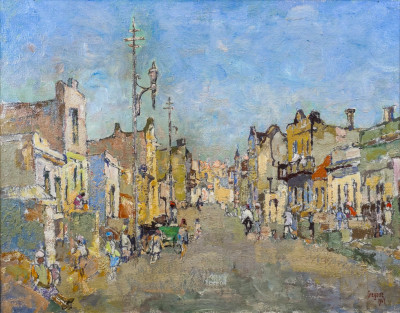
Gregoire Boonzaier (1909–2005) was one of the leading painters of Cape Town’s urban and suburban landscape in the 20th century and a founding member of the New Group, which sought to bring a modernist sensibility to South African painting from the late 1930s onwards.
Born into an artistic family in Cape Town, he received early encouragement from figures including Moses Kottler and Nita Spilhaus before travelling to London to study. In England, he absorbed lessons from the post-impressionist tradition that informed his approach to colour, composition and the rendering of observed reality. Boonzaier is closely associated with images of District Six, the Bo-Kaap, the older residential neighbourhoods of Cape Town, rural villages, still-life arrangements and scenes of working people.
His work combines the warmth of intimate observation with a formal clarity derived from his modernist training, producing images that are at once socially engaged and aesthetically refined.
He brought a consistent humanity to his subjects, treating the everyday life of Cape communities with the same formal attentiveness he gave to landscape or still life. This combination of accessibility and pictorial intelligence ensured that his work found audiences across several generations of South African viewers and collectors. Boonzaier was prolific and remained active well into his later years, continuing to paint and advocate for making art available to broader audiences. His images of District Six and the Bo-Kaap now carry additional historical weight as visual records of communities irreversibly disrupted by the forced removals of the apartheid era.
His paintings are held in major South African collections and his contribution to Cape painting, and South African modernism more broadly, remains substantial.