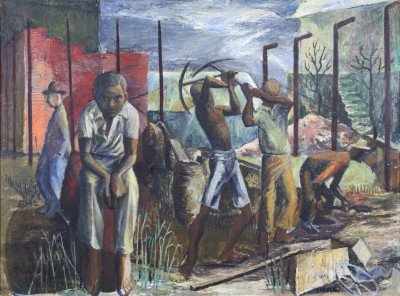
Bill Ainslie (1934–1989) was a South African painter, teacher and cultural catalyst whose influence on the country’s art was felt as much through his institutional commitments as through his own studio practice. He trained in the arts and initially pursued a career in teaching before devoting himself fully to painting.
His early figurative work often involved labouring bodies and landscape, while his later practice moved decisively towards abstraction, exploring form and gesture in ways that reflected both international currents and the pressures of life under apartheid. Ainslie’s deepest legacy lies in his educational and cultural work.
He was a central figure in the Johannesburg Art Foundation, which he helped to develop into one of the most important non-racial art schools in South Africa during the apartheid era. The Foundation offered access to professional studio training regardless of race at a time when such spaces were rare and often under threat. Ainslie also played a key role in the development of the Foundation for the Creative Arts (FUBA) educational programmes and was instrumental in shaping the Thupelo workshop model, which brought South African artists into exchange with international peers and provided crucial platforms for black artists excluded from mainstream institutions. The artists who passed through Ainslie’s sphere of influence include many of the most significant figures of the late 20th century in South African art. His personal generosity, intellectual seriousness and commitment to equality shaped not only individual careers but also the broader cultural terrain of a generation.
Ainslie died before the democratic transition he had worked towards could be fully realised, but his impact on South African art education and practice endures.